

Over the next few days, I refined the plan. In my gut, Saturday’s ridge spot didn’t feel right—it was too close to the animal path, the badger setts, and a couple of faint footpaths. Combined with the exposure on the ridgeline, I couldn’t shake the unease.
I went back to the OS maps and digitally scouted a flatter, unmanaged pocket of woodland. Even though it sat right behind a large housing estate, there were deep sections with absolutely no trails running through them. I plotted a new route with a backup location nearby. I ate dinner, took a shower, and brushed my teeth before leaving—I wanted to treat this purely as a test of my sleeping setup without any extra logistics to worry about.
As I repacked my bag one last time, panic set in and I over-packed on water. My pack weighed in at 13kg. Lifting it onto my back, the weight caught me off guard, but I knew if I stayed to rethink my kit, I wouldn’t leave. I walked out the door.
The woodland begins just five minutes from my house, starting with a steep incline. Feeling the straps dig in on the hill, I had to laugh at how much gear I thought I needed for a single night. The irony was as I didn’t want to face the dark to pee in the middle of the night, I set a strict water cutoff for 7:30 PM. Once I was in that sleeping bag, I didn’t want to get out until morning.
The first stretch was an uneventful, familiar trail I walk with the dog, though I passed a few evening dog walkers who I felt were eyeing my massive rucksack. Turning down the final footpath, my destination came into view. The sun was setting to my right, pushing a warm, strong wind across an open field. I stripped some seeds off a stalk of grass and tossed them into the air to confirm the direction—it was coming from the west. I used the setting sun as a visual anchor, knowing I wanted to keep a thick buffer of trees between myself and the exposed field.
I turned into the woods, tracking the border path that ran parallel to the field. Halfway in, the woodland grew dense. A cluster of massive holly bushes offered excellent cover from both the trail and the field. That was my cue. I turned off the path and broke into the overgrowth. Fighting through the brambles and knee-high ground cover brought back that sharp feeling that I wasn’t supposed to be there, but the rhythm came back quickly. My footsteps sounded incredibly loud on the dry woodland floor, so I stopped periodically to listen. Silence.
I needed flat, clear ground, which was hard to find among the brambles. I noticed that beneath the oldest oak trees, the heavy canopy blocked the sunlight, leaving the woodland floor relatively clear. I dropped my pack under a beautiful oak tree flanked by holly and raised a plow-point shelter.
But standing back to examine it, the setup felt far too exposed. I marched ten meters north to check my perimeter and immediately hit an internal trail. Looking back toward my camp, the camouflage tarp was clearly visible through the patchy cover. To make matters worse, I walked down to a bend in the trail and found fresh bike tire tracks. I had to move.
It was 8:30 PM. The sun was dipping and the dense woods were darkening, but I still had light. I pulled down the tarp, grabbed my gear, and looked west toward a thicker wall of holly. This time, I was going to get properly tucked away. I found two perfect trees for a ridgeline, cleared the floor of sharp debris, and pitched an adirondack configuration to utilize the extra space.
It looked handsome. The lines were taut, the stakes secure. I tossed my bag inside and stepped back to perform another perimeter check. The space was tighter over here, and to exit, I had to duck under a thick branch. As I placed my hand on it to pivot, the entire length shifted.
It was dead. A massive widow-maker, hanging directly over the center of my shelter.
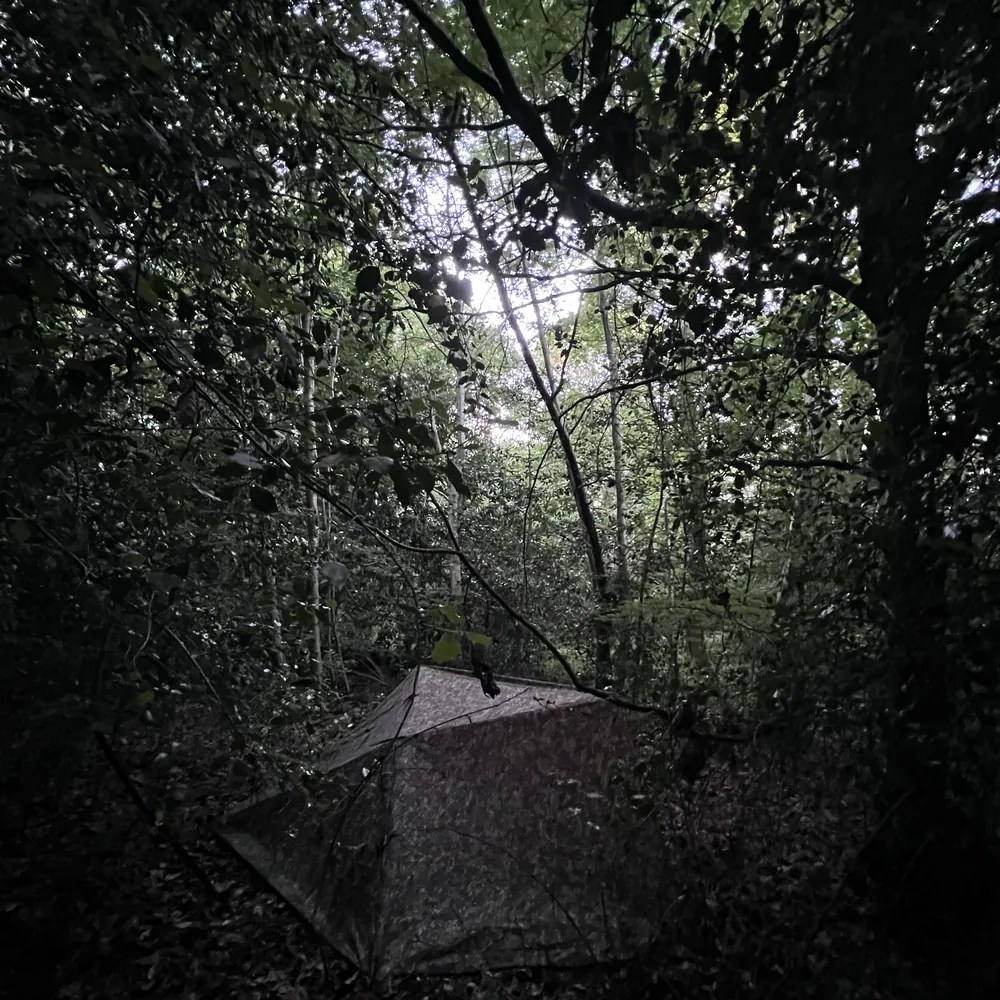
I felt a wave of irritation. I had put so much effort into making the tarp look perfect. What were the actual chances of it falling tonight? Could I just risk it? I looked up. The tops of the trees were swaying violently in the high wind. It was getting dark quickly, but I couldn’t ignore it. I would feel like an idiot if I got crushed on my very first night out.
I moved one last time, just around the corner of the holly tree into a small, clean opening. It had solid trees for a ridgeline, a clear floor, no animal signs, total concealment from the path, and a perfectly safe canopy overhead. By the time the sleeping kit was deployed, it was completely dark. I crawled into my bag and settled in for the night.
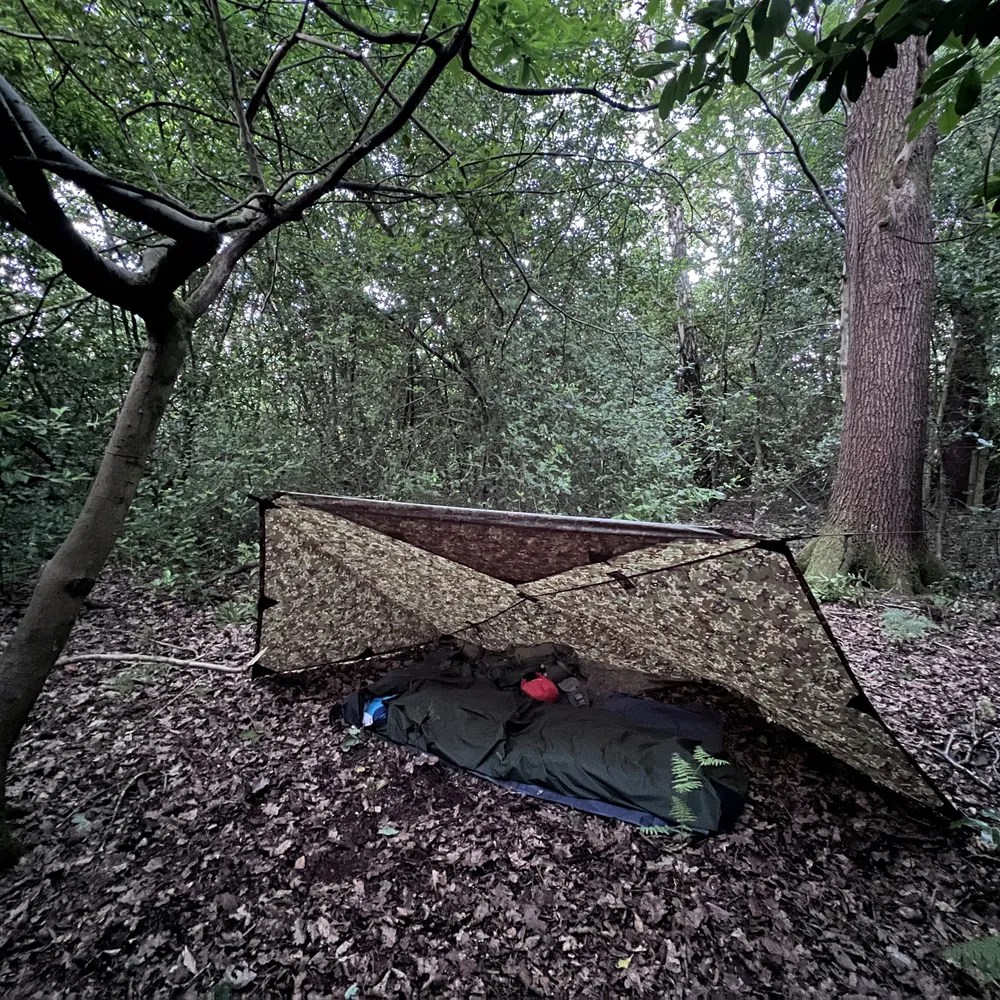
I woke up several times. It was one of those nights where you feel suspended halfway between sleep and consciousness, yet hours pass in an instant. At one point, a loud, piercing shriek from a bird right above my head startled me awake. My immediate, groggy thought was, Great, is this going to happen all night? But I caught myself. This was exactly why I was here—to share this space with the wildlife. I couldn’t be angry at it.
I finally stirred for good at 5:00 AM. The sun was up, bathing the woods in light. Looking up through the canopy, the early light filtering through the moving leaves made the trees look like they were twinkling in a sleepy wonder. I had done it.
The morning birdsong was deafening. Above me, the wind moved through the treetops in great, rolling waves. I lay there a little longer, a familiar trace of anxiety creeping in about being spotted now that it was fully light. The classic stealth camping wisdom echoed in my head: set up at last light, leave at the first. The sun had been up for half an hour, and I was close to the horse paddocks.
I took a breath and listened. Still nothing. I thought about trying to squeeze in another thirty minutes of sleep, but thought better of it. I had accomplished what I came to do.
Packing went incredibly fast. Once the bag was zipped, I nearly marched straight out to the path, but I caught myself, stopped, and decided to make breakfast instead.
Thirty meters away, a fallen tree rested against two upright oaks, creating a perfect natural chair cushioned with thick green moss. The wood was damp, so I lined it with my ground sheet, set up my traditional alcohol stove, and put the water on to boil for my coffee and porridge. I leaned back and watched the sun sparkle through the branches.
Breakfast brought me face-to-face with the final anxiety on my checklist: pooping in the woods. I had prepared for this—cat-hole trowel, toilet paper, and plastic disposal bags to pack it all out. The experience was entirely liberating. Crossing that final barrier off my list made me feel physically and mentally lighter.
I packed the stove away and began the walk home, pausing to silently thank the trees that had sheltered me through the night.
With a cup of leftover coffee in hand, I found the main path and took my time walking out. On the way in, I had been completely trapped in my own head, consumed by logistics. Walking out, it felt like I had woken up in an entirely new world.
I spotted massive, ancient oak trees contorting themselves over centuries to catch the sun. Tiny birds with bright yellow beaks hopped between branches, singing right in front of me. I passed a giant horse chestnut tree that had been split by a storm, its broken limbs somehow still growing in beautiful, chaotic shapes. A large bird of prey flashed silently across the path, and a young fawn and its mother bounded through the brush ahead of me.
It felt like an exotic wilderness holiday, yet I was barely two miles up the road from South Croydon. Waking up that morning, everything had changed.
 There is a Man in the Woods
Leave a comment